








Which is the more secure CMS?
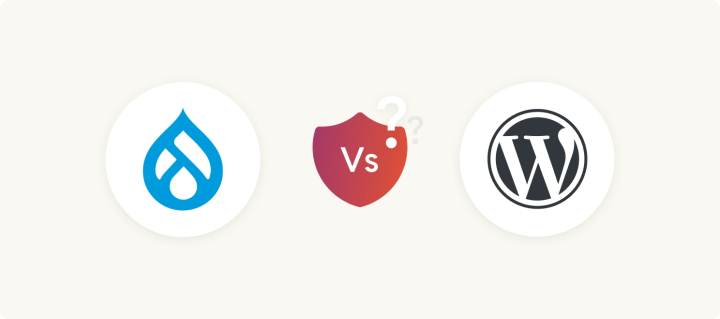
The Drupal vs WordPress security debate generates more noise than signal. Both platforms are demonstrably secure at the core, with confirmed vulnerabilities largely appearing in their module and plugin ecosystems. So, which exact platform has the edge over the other when it comes to security? We’ll take a closer look at the nuances in this handbook article.
Drupal’s “secure by default” architecture
Drupal commands a strong reputation for security. Since Drupal 8, Twig templating auto-escapes all output by default. Every variable is HTML-escaped unless a developer explicitly overrides it.
WordPress’s PHP templates require developers to call esc_html() on every output, a manual step, but WordPress’s mature escaping API and code review culture have kept core XSS incidents to near zero.
CSRF protection follows the same pattern. Drupal integrates token validation declaratively into routing. WordPress uses nonces that developers must manually manage. Although Drupal’s approach is harder to misuse, WordPress’s approach is more familiar to the broader PHP developer pool, which lowers onboarding time for security-conscious teams.
Core vulnerability counts are nearly identical
WordPress disclosed ~14 core vulnerabilities across 2023–2025. Drupal issued 22 core Security Advisories, though five addressed gadget chain issues described as “not directly exploitable.” The overwhelming majority on both sides were medium-severity.
The “WordPress is insecure” claim is, in fact, a myth that collapses under scrutiny. In 2024, just 7 of 7,966 ecosystem vulnerabilities affected WordPress core (Patchstack). In 2025, core accounted for 6 of 11,334. WordPress core is, statistically, one of the most secure codebases in the open-source CMS category.
The source of security risks
The risk surface for both Drupal and WordPress lies in the module/plugin ecosystem, not the core.
For all the Drupal to WordPress migrations we carry out at rtCamp, we reduce the risk of every possible security vulnerability by vetting plugins, enforcing update policies, and layering Web Application Firewalls.
Compliance depends on hosting, not core
In the Drupal ecosystem, the leading vendor, Acquia, holds advanced security compliance certifications.
WordPress, on the other hand, has a vast hosting ecosystem, and compliance depends on individual hosts. WordPress VIP, the top enterprise-ready platform for WordPress, achieved FedRAMP Moderate ATO in April 2025 and holds GovRAMP and TX-RAMP certifications.
When our teams at rtCamp operated in U.S. federal or financial services environments, we worked with platform-level compliance already provided by WordPress VIP.
WordPress security scales with less effort
Automatic background updates, shipping since version 3.7 of WordPress, push security patches to production without waiting on a developer. Drupal sites, on the other hand, must be manually patched.
Key takeaway
🏆WordPress wins on operational security: Automatic patching, an 8-million-install security plugin ecosystem, a strong pool of expert developers, and WordPress VIP’s FedRAMP authorization deliver enterprise-grade security with lower ongoing operational effort.
Where Drupal holds ground: Drupal is a close runner-up in our assessment here. Twig auto-escaping, declarative CSRF protection, and Acquia’s compliance portfolio make Drupal a strong choice for strict regulatory requirements where a single vendor must cover compliance end-to-end.
Considering a migration from Drupal to WordPress? Get in touch with us to know more.
