








Contentful alternatives in 2026: A guide for enterprise teams
Contentful built the headless CMS category. It also landed on a pricing model that charges across users, locales, API calls, and spaces simultaneously. Every team that grows on it pays more for its own success. If you’re evaluating Contentful alternatives, that dynamic is probably what brought you here.
This guide covers the eleven strongest Contentful competitors in 2026, split across direct headless CMS replacements and enterprise DXP upgrades. We’ve matched each to the specific constraint it resolves.
In our experience migrating enterprise teams off Contentful, the frustration almost always comes down to one of four things:
- A pricing model that charges more as you grow.
- Editorial teams that are dependent on developers to publish a content piece.
- An architecture blocked by read-only GraphQL.
- A migration cost nobody budgeted for when they signed the contract.
Use the sections below to find the one that fits yours.
Note: rtCamp is an enterprise WordPress agency and a WordPress VIP partner. We’ve tried to be as objective as possible throughout this guide, but it’s worth knowing where we’re coming from. The strengths and trade-offs of every platform here are our honest assessment.
Why teams leave Contentful in 2026
If you’ve run Contentful for more than two years at scale, at least one of these will sound familiar.
Pricing compounds as you grow
Contentful charges across users, locales, API calls, and spaces simultaneously. Enterprise contracts run a median of $51,408/year before overages, with API and environment additions adding 20–50% on top in practice.
Pricing is the most frequently cited complaint across G2 reviews, mentioned in seven separate reviews has described consistently as pricing that “becomes expensive for growing teams or enterprise-level usage.” For a full cost breakdown, see our Contentful vs WordPress total cost of ownership comparison.
Rich Text is a developer tax
Contentful outputs Rich Text as structured JSON, not HTML. Rendering it requires custom frontend logic that can grow substantially. A published case study documents a React component exceeding 500 lines written solely to handle Rich Text rendering.
GraphQL has hard limits
Contentful’s GraphQL API is read-only which teams can query content but cannot create, update, or delete it via GraphQL, which means any write operation has to go through the REST API instead.
Requests are also capped at 8KB. G2 reviewers flag the combination of complex data modelling and GraphQL API constraints as a recurring friction point, with five separate reviews citing it as a factor that slows developer adoption. For teams running GraphQL-native architectures, this is a hard limit baked into the platform’s design.
Exit costs are higher than teams expect
Contentful stores Rich Text as a proprietary JSON abstract syntax tree as it cannot be parsed by generic tools and no off-the-shelf library handles the transformation end-to-end. Every migration requires a custom converter. The longer a team has run on Contentful, the higher that exit cost grows.
Contentful alternatives in 2026: At a glance
The table below covers all eleven Contentful headless CMS alternatives alongside the full DXP options in one view. The platforms below the headless CMS group (AEM, SitecoreAI, Optimizely) are platform-category upgrades. Teams evaluating those are asking whether they need a full Digital Experience Platform.
Note on pricing: All figures in the table above are sourced from publicly available pricing pages and third-party research at the time of writing. Pricing for SaaS platforms changes frequently and higher tiers are often negotiated directly with vendors. Verify current pricing on each platform’s website before making procurement decisions.
How each Contentful alternative stacks up
WordPress (headless)
Best for
Teams at any scale that need platform ownership without vendor pricing constraints — from developer-led API-first builds to large editorial teams, multi-brand publishers, and regulated enterprises. The only platform in this guide that covers self-hosted, mid-market managed, and enterprise-grade hosting without a platform change.

If your primary frustration with Contentful is the pricing model, WordPress removes the metered structure entirely. It delivers structured content via REST API and WPGraphQL, supporting any frontend framework your team is already using.
Content models built through Custom Post Types (CPT) and custom fields are version-controllable and owned entirely by your organization, no content-type ceilings, no vendor lock-in.
Pros
- No per-user, per-locale, or per-API-call fees at any tier with no content-type ceilings, full data portability
- Full WPGraphQL support including mutations, no request size cap
- Gutenberg block editor gives editorial teams visual, WYSIWYG publishing without developer involvement
- Native MCP adapter in WordPress 6.9 enables unrestricted AI agent integration
- WordPress VIP adds FedRAMP Moderate Authorization, SOC 2 Type II, and 99.99% uptime SLA
- Real-time collaborative editing already live for WordPress VIP customers, and shipping to WordPress core in WordPress 7.0 as opt-in, closing a gap that previously distinguished SaaS-only platforms
- Native multisite support with no per-space pricing
- Among sites with a known CMS, WordPress powers 52.1% of the top 10,000 websites and 50.2% of the top 1 million, per W3Techs
- Enterprise brands running on WordPress include Microsoft, IBM, Disney, Salesforce, SAP, and Mercedes-Benz
- WordPress VIP customers include Time, TechCrunch, Fortune, and BBC America
Cons
- Not turn-key SaaS with the headless configuration is a build, not a default
- Self-hosted deployments require DevOps discipline for patching, update governance, and infrastructure management
- Faster to deploy alternatives exist for teams needing a productive headless CMS within days
Verdict
WordPress VIP pairs FedRAMP Moderate Authorization with zero metered pricing and it’s where we take enterprise clients who’ve outgrown Contentful’s cost model. The open architecture means no ceiling on content types, API calls, or locales, and no vendor permission required to integrate any LLM or AI workflow.
If you’re already decided on moving, rtCamp’s Contentful to WordPress migration guide covers the full technical process or if you’d rather have a team handle it, see our Contentful to WordPress migration services.
Sanity
Best for
Developer-led teams who need schema-as-code content modelling, real-time collaboration, and no content-type ceilings.

If your team version-controls everything, including content architecture, Sanity fits naturally into that workflow. Content models are defined in JavaScript or TypeScript, so schema changes go through pull requests, not a GUI.
Real-time collaborative editing is native, with multiple authors working simultaneously without conflict. There are no content-type limits at any tier.
Pros
- Schema-as-code content modelling, version-controlled alongside application code
- Real-time collaboration native to the platform, no conflict resolution needed
- No content-type or locale limits at any tier
- Free plan includes 20 user seats; open-source Studio is a fully customisable React application
Cons
- Studio requires developer time to configure, not polished out of the box for non-technical editors
- GROQ is proprietary and does not transfer to other platforms
- Free plan caps at 10,000 documents, a hard ceiling for content-heavy deployments
- Pricing scales with API calls, bandwidth, and data storage at higher volumes
Verdict
The schema-as-code approach is what differentiates Sanity for engineering teams who version-control everything. If Contentful’s UI-driven content modelling has been a friction point, Sanity removes that constraint. GROQ is proprietary, though, and won’t transfer if you move again.
Storyblok
Best for
Marketing-led teams that need visual page building and publishing independence from developers.
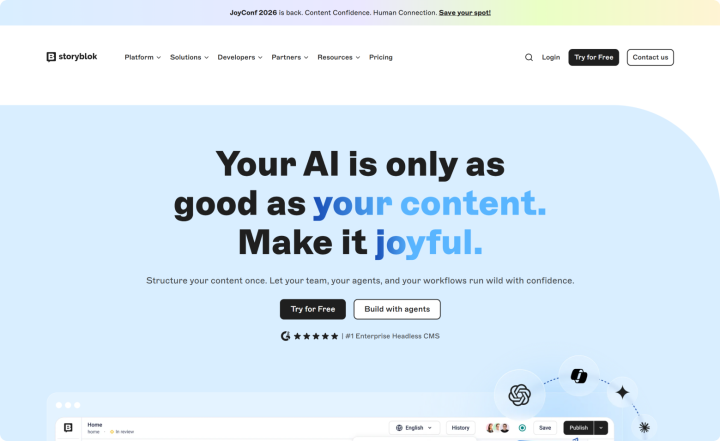
Storyblok‘s Visual Editor shows live page previews across desktop, tablet, and mobile as editors work. Content teams can create, update, and publish pages without developer involvement. The component-based “Blok” system lets developers define reusable components once, and editors assemble pages from them without touching code.
Pros
- WYSIWYG Visual Editor with real-time preview across desktop, tablet, and mobile
- Component-based architecture gives developers architectural control while freeing editors
- 4.4/5 on G2 across 562 verified reviews and 71 awards in G2 Spring 2026; Customers’ Choice in the 2023 Gartner Peer Insights Voice of the Customer; IDC MarketScape Leader 2025
- ISO 27001 and SOC 2 Type II certified, with enterprise governance and audit trails
Cons
- Visual-first design optimizes for web pages, less suited for purely API-driven multi-channel delivery to mobile apps or IoT devices
- Pricing escalates at scale, per-user and per-locale charges apply on higher tiers
- Plugin marketplace smaller than Contentful’s with fewer native integrations and community resources
Verdict
If editors are filing developer tickets to publish a paragraph, Storyblok is built to stop that. Less suited for teams whose primary requirement is API-driven delivery across non-web channels.
Contentstack
Best for
Enterprises needing governed workflows, native personalisation, and multi-brand digital experience management.
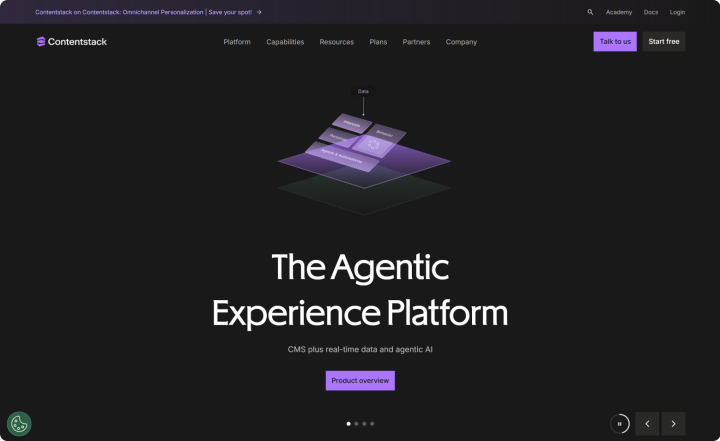
Contentstack is built around governed content workflows, fully extensible, with multi-reviewer enforcement, named workflow stages, and comprehensive audit logs.
In December 2024, Contentstack acquired Lytics, a real-time customer data platform, bringing content management and first-party data into a single platform.
Pros
- Only pure headless CMS named a Forrester Wave CMS Leader Q1 2025 and IDC AI-Enabled Headless CMS Leader 2025
- Native CDP integration via Lytics acquisition enabling content and customer data in one platform
- Fully extensible workflows with multi-reviewer enforcement and audit logs
- Pirelli deployed 218 sites in 10 months with 75% faster publishing; customers include AirFrance KLM, Burberry, Mattel, and Walmart
Cons
- Entry pricing of $995/month makes it one of the more expensive options in this guide
- Ecosystem smaller than Contentful’s, fewer third-party integrations, narrower community
- Implementation is typically partner-led and not fast to deploy
Verdict
Contentstack is the enterprise headless CMS that takes governance seriously with documented approval chains, audit logs, and a Forrester Wave leadership position to back it up. Entry pricing of $995/month means it only makes economic sense at enterprise scale.
Strapi
Best for
Developer-led teams who need self-hosting, open-source infrastructure ownership, and zero metered costs.
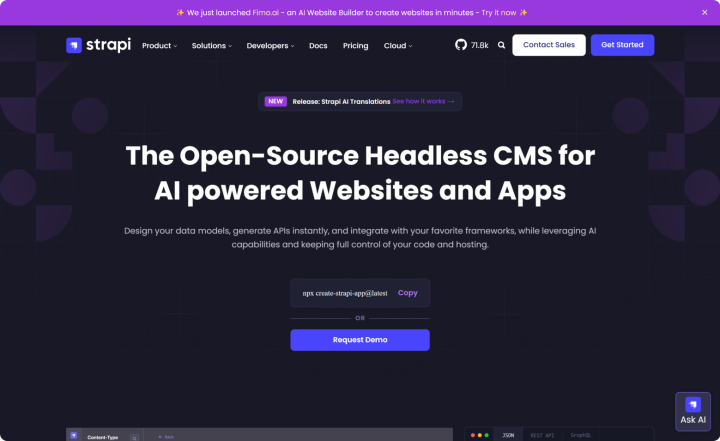
Strapi‘s Community Edition is free, MIT-licensed, and self-hosted with no content type, locale, entry, or admin user limits. Teams leaving Contentful because of its pricing model will find none of those metered constraints here.
With 70K+ GitHub stars and 20M+ downloads, Strapi has production deployments at enterprises including Adidas, Airbus, Amazon, and Cisco. The admin panel exposes REST and GraphQL by default, with no vendor lock-in on the data layer.
Pros
- Free self-hosted Community Edition, no content type, locale, entry, or user limits
- MIT licence with full code ownership, no vendor dependency
- REST and GraphQL APIs out of the box with no per-API-call fees at any tier
- Cloud-hosted option from $29/month for teams that prefer managed infrastructure
Cons
- Self-hosted deployment requires DevOps discipline, and infrastructure, security patching, and updates fall on your team
- Visual editing limited to admin UI only, not suitable for marketing teams needing WYSIWYG publishing
- Enterprise compliance certifications depend entirely on your hosting choices, so the platform itself carries none
- Not natively AI-first and AI capabilities come through the plugin ecosystem
Verdict
If the primary goal is removing every metered pricing constraint and owning the infrastructure entirely, Strapi delivers that cleanly. Not suited for editorial-led or marketing-first teams who need visual publishing tools.
Kontent.ai (formerly Kentico Kontent)
Best for
Large editorial teams in regulated industries needing AI-powered content operations with strict workflow governance.
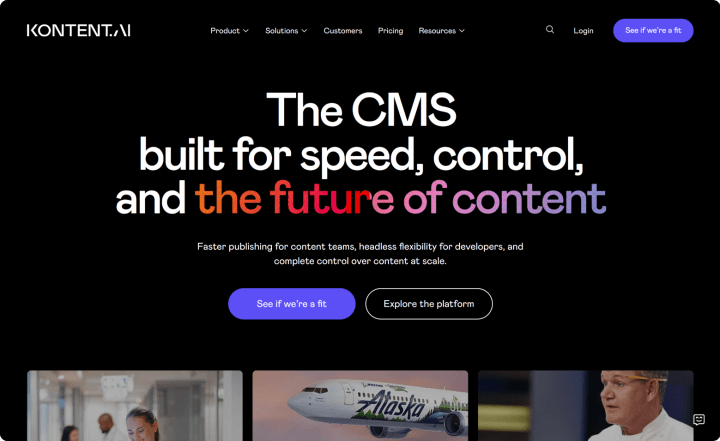
If your team publishes in a regulated environment where every piece of content needs an approval trail, Kontent.ai is built for that. Native AI content intelligence sits directly inside the editorial workflow, supporting content generation, review, and approval within a single governed environment.
Fine-grained role permissions, full audit trails, and regulated-industry compliance make it a serious option for financial services, healthcare, and public sector teams where publishing carries legal or compliance weight.
Pros
- Native AI content intelligence integrated directly into editorial workflows
- Full audit trail support and fine-grained role permissions at every workflow stage
- Built for regulated industries like financial services, healthcare, public sector track record
- Enterprise SLAs with dedicated support and strong multi-language capabilities
Cons
- Pricing not publicly listed and requires a sales conversation before any cost visibility
- Limited visual editing for marketing teams compared to Storyblok
- Implementation complexity is high, not a fast-to-deploy platform
Verdict
Kontent.ai is purpose-built for editorial teams where publishing carries legal or compliance weight. If that combination of governance and AI content operations is the primary requirement, few platforms are as well-suited for it.
Hygraph (formerly GraphCMS)
Best for
GraphQL-native teams who need full mutations, content federation, and mission-critical API performance.

If your team runs a GraphQL-native architecture, Contentful’s read-only GraphQL with an 8KB request cap creates a structural constraint. Hygraph supports full mutations, content can be created, updated, and deleted via GraphQL with no request size cap and content federation across multiple data sources.
Pros
- Full GraphQL mutations with no request size cap, removes Contentful’s 8KB structural constraint
- Content federation, query across multiple content sources in a single GraphQL endpoint
- Telenor runs millions of monthly API calls at max 100ms latency; Samsung is also an anchor customer
- Free tier; Professional from $299/mo, Scale from $799/mo
Cons
- Visual editing is limited. Hygraph is structured content-first, not designed for WYSIWYG publishing
- Smaller ecosystem than Contentful with fewer native integrations and community resources
- Not suited for teams where content and marketing drive the workflow
Verdict
Hygraph solves a specific problem, GraphQL mutations and content federation, and solves it well. If those aren’t your documented blockers, the GraphQL-first model adds complexity without proportional benefit.
Enterprise DXP upgrades
The platforms below are platform-category upgrades. If you’re evaluating these, the question on the table is whether your team needs a full Digital Experience Platform.
WordPress (DXP)
Best for
Enterprises that need a composable DXP with content, commerce, personalization, and AI workflows under an open-source platform they own entirely.
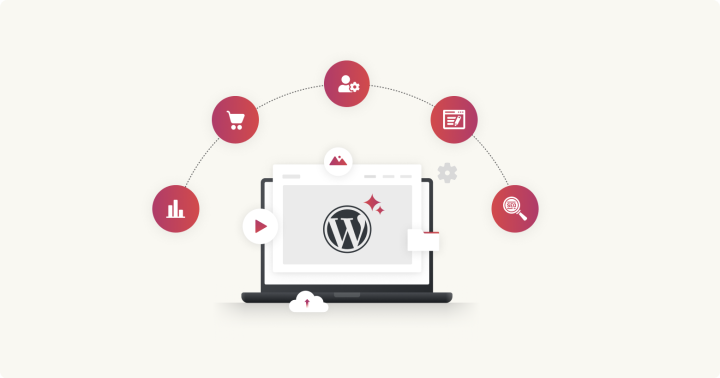
WordPress is the only platform in this guide that operates as both a direct headless CMS replacement and a composable DXP alternative to AEM or Sitecore. Its open architecture means content, commerce, personalisation, and AI workflows can be assembled without locking into a single proprietary vendor stack.
Before reaching for a full headless architecture, though, it’s worth asking whether you actually need one. If your primary channel is the web, modern native WordPress delivers app-like experiences without the fragmentation tax of decoupled frontends.
Block themes, the Interactivity API, and the Abilities API in WordPress 6.9 give you structured content, dynamic interactivity, and AI-agent integration natively. Reserve headless for multi-channel requirements like mobile apps, kiosks, and IoT devices.
Where AEM and Sitecore charge six figures for platform access alone, WordPress’s open-source core carries no licensing fee. WordPress VIP adds FedRAMP, SOC 2, and a 99.99% uptime SLA at a fraction of what proprietary DXPs charge for comparable infrastructure. The trade-off is that composable architecture means assembling the stack yourself rather than receiving a pre-integrated suite.
Verdict
If you’re looking at AEM or SitecoreAI pricing and wondering whether there’s an open-source path to the same capability, WordPress is the answer. For a full breakdown, see our WordPress as a composable DXP guide.
Adobe Experience Manager
Best for
Global enterprises deeply embedded in the Adobe full stack with Analytics, Target, Campaign, and Creative Cloud used as core marketing infrastructure.

Adobe Experience Manager requires a full-stack commitment to the Adobe ecosystem. Teams considering it typically already run Adobe Analytics, Target, and Campaign. AEM is the content layer that completes that investment. If you’re evaluating it as a standalone Contentful replacement without that Adobe foundation, the cost-to-capability ratio is unfavorable from the start.
Licensing alone runs $80,000 to $200,000 annually, and a typical five-year TCO lands between $900,000 and $1.8M once you factor in hosting, maintenance, and implementation.
Verdict
AEM makes sense only if your organisation is already running Adobe Analytics, Target, and Campaign. As a standalone Contentful replacement without that foundation, the licensing cost rarely justifies the switch.
SitecoreAI (formerly Sitecore XM Cloud)
Best for
Enterprises with deep Microsoft/.NET investment needing native personalization and CDP at scale.

If your team runs sophisticated personalization programs, SitecoreAI‘s native personalization engine handles CDP, audience segmentation, and A/B testing directly inside the CMS, with no third-party layer to manage.
SitecoreAI is Sitecore’s unified SaaS platform. Headless-first, JavaScript frontend (Next.js/JSS), and composable, with CMS, personalization, and AI modules all under a single license.
Pricing isn’t publicly listed, and Sitecore partners can’t disclose pricing structures openly. Annual licensing runs $60,000 to $150,000, with a typical five-year TCO of $700,000 to $1.5M once hosting, maintenance, and composable module costs are included.
Verdict
SitecoreAI is well-suited for enterprises already running Microsoft/.NET infrastructure who need native personalisation without a third-party CDP layer. For teams moving from Contentful without that existing investment, the implementation overhead is difficult to justify.
Optimizely CMS
Best for
Enterprises where content management and experimentation are a unified operational requirement.
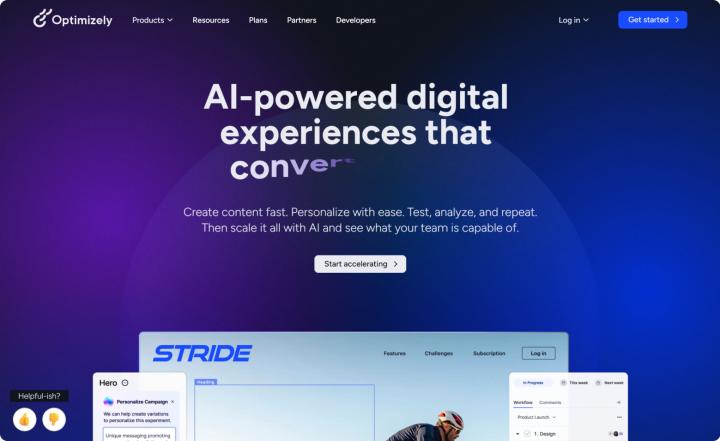
Optimizely is the only platform in this guide where A/B testing, multivariate testing, and feature flags live inside the CMS itself, with no third-party layer to manage. For teams that need experimentation integrated with their CMS rather than connected via a third party, this removes an integration layer that other platforms require.
Pricing isn’t publicly listed, costs scale with traffic and product mix. The Forrester Wave CMS Q1 2025 gave Optimizely its highest marks for Vision, Innovation, and Content Generation, but the platform is notoriously complex to implement and requires specialist expertise.
Verdict
Experimentation is baked into the CMS here, and that’s what justifies the complexity. If you’re evaluating it purely as a CMS replacement, the cost and implementation timeline are difficult to justify.
Two platforms worth watching
Payload CMS
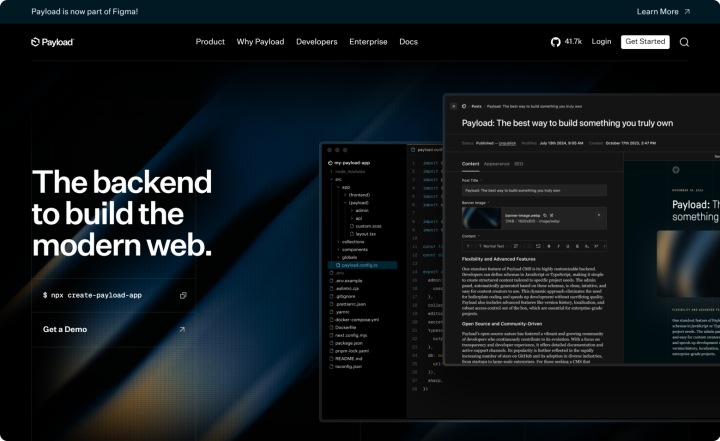
Payload CMS is TypeScript-first, Next.js-native, and code-defined. The entire CMS configuration lives in TypeScript files alongside the application. With 41K+ GitHub stars and growing npm adoption, it has established traction among TypeScript-native developers.
Figma acquired Payload in June 2025, and the weekly release cadence has continued unchanged post-acquisition. Its customer roster includes Disney, Blue Origin, Microsoft, and ASICS. Payload is best evaluated as a Strapi alternative for TypeScript-native teams, not as a fit for organizations where editors or marketers drive publishing.
Directus

Directus wraps an existing SQL database in a REST and GraphQL API instantly, without forcing schema changes. It suits teams with existing data infrastructure that want a content management layer over it — not a new content store. If your team already has structured data in a database and needs editorial access to it, Directus is worth evaluating ahead of any purpose-built headless CMS.
Which Contentful alternative fits your team?
- If your team needs platform ownership with no licensing cost, no per-user pricing, and unrestricted AI integration at enterprise scale: WordPress headless on WordPress VIP. FedRAMP Moderate Authorization and zero metered pricing, in one platform. See our Contentful to WordPress migration services.
- If your team needs developer-first schema-as-code control with real-time collaboration and no content-type limits and you’re comfortable with a proprietary SaaS platform and GROQ vendor lock-in: Sanity.
- If your team needs visual page building with no per-user fees at any tier: WordPress with Gutenberg gives marketing teams full WYSIWYG publishing independence. For component-based visual page building in a pure SaaS environment, Storyblok is the alternative to evaluate.
- If your team needs enterprise-governed workflows, native personalization, and a Forrester Wave-recognized headless platform: Contentstack, the only pure headless CMS named a Forrester Wave Leader in Q1 2025.
- If your team needs open-source self-hosting with no per-user, per-locale, or per-API-call pricing, WordPress and Strapi are both free at the core with no metered fees. Strapi is the leaner API-first option. WordPress brings a broader editorial layer and a hosting ecosystem that scales from self-managed to fully managed enterprise.
- If your team publishes in a regulated environment like financial services, healthcare, public sector and needs AI content operations inside a fully governed, audit-trailed workflow: Kontent.ai.
- If your team’s GraphQL architecture requires mutations, content federation, or requests beyond 8KB: Hygraph, built specifically around the GraphQL constraints Contentful’s implementation cannot resolve.
- If your team is building a TypeScript-first Next.js application and wants the CMS inside the codebase: Payload CMS, code-native configuration, version-controlled schemas, no HTTP layer overhead.
- If your team needs a full Digital Experience Platform, WordPress works as both a direct Contentful replacement and a composable DXP alternative, with full platform ownership. See our WordPress as a composable DXP guide.
- If your team needs a full Digital Experience Platform from a single proprietary vendor then evaluate AEM, SitecoreAI, or Optimizely, but understand this is a platform-category upgrade that adds significant cost and implementation complexity.
Every team we’ve worked with has had a specific constraint that drove the evaluation. The platform that removes it is your answer.
Frequently asked questions: Contentful alternatives
What is the best alternative to Contentful?
There is no single best alternative. The platform worth choosing depends on your team’s primary constraint.
For enterprise teams managing cost and platform ownership, WordPress headless on WordPress VIP resolves Contentful’s metered pricing with zero per-user, per-locale, or per-API-call fees.
For developer teams prioritizing real-time collaboration and schema flexibility, Sanity deserves a look. Its schema-as-code approach and no content-type limits at any tier address the modelling constraints Contentful imposes.
For marketing teams needing visual editing without developer involvement, start with WordPress. Gutenberg’s block-based editor gives editorial teams full publishing independence at no additional cost. For teams that want component-based WYSIWYG editing in a pure SaaS environment, Storyblok is one option to consider.
Is there a free alternative to Contentful?
Yes. Strapi’s self-hosted Community Edition is free with no content type, locale, entry, or admin user limits. WordPress is also free and open-source at the core, with no licensing fees at any tier. Both require self-managed infrastructure. Cloud-hosted options for both introduce costs.
What is the best open-source alternative to Contentful?
Strapi is the leading open-source headless CMS alternative, with 70K+ GitHub stars and 20M+ downloads. WordPress is the most deployed open-source CMS globally, among sites with a known CMS, it powers 52.1% of the top 10,000 websites. Strapi is better for API-first application development. WordPress headless is better for content-heavy editorial operations at enterprise scale.
Why do companies leave Contentful?
The most consistent reasons, based on G2 and Capterra reviews and enterprise buyer data, fall into four categories.
Pricing that scales with users, locales, API calls, and spaces simultaneously, driving costs up as organizations grow. Content-type limits that surface as architectural ceilings mid-project. No GraphQL mutation support, limiting teams to read-only GraphQL. And Rich Text output that requires substantial custom frontend rendering logic.
What is the best Contentful alternative for enterprise?
For enterprises prioritizing platform ownership and AI integration, WordPress headless on WordPress VIP is where we’d start. It combines FedRAMP Moderate Authorization with zero metered pricing.
For enterprises prioritizing governed workflows and native personalization, Contentstack makes the shortlist. It’s the only pure headless CMS named a Forrester Wave Leader in Q1 2025.
For enterprises needing AI content operations with strict editorial governance, Kontent.ai.
How does WordPress compare to Contentful as a headless CMS?
WordPress delivers structured content via REST API and WPGraphQL, supporting any frontend framework. Unlike Contentful, it has no per-user, per-locale, or per-API-call fees at any tier, no content-type ceilings, and its open architecture allows any LLM integration without vendor permission.
WordPress headless does require more developer setup than commercial SaaS alternatives. At enterprise scale with WordPress VIP, WordPress adds FedRAMP compliance and 24/7 engineering support. See the full Contentful vs WordPress comparison for a detailed breakdown.
What is the best Contentful alternative for visual editing and marketing teams?
WordPress is worth considering first. Gutenberg’s block-based editor gives marketing teams a WYSIWYG publishing environment with no developer involvement required, and it comes with no per-user fees at any tier.
For teams that want component-based visual page building in a pure SaaS environment, Storyblok fits that requirement well. Its Visual Editor shows live page previews across devices, and marketing teams can publish without filing a developer ticket. Kontent.ai and Contentstack also offer visual editing with stronger enterprise governance at the high end.
What are the technical limitations of Contentful that drive developers to look for alternatives?
Three constraints come up most consistently in developer reviews. Contentful does not support GraphQL mutations, so content can be queried but not created or updated via GraphQL. GraphQL requests are capped at 8KB, limiting complex queries. And Rich Text fields output structured JSON that requires substantial custom frontend rendering logic.
Content-type limits also act as architectural ceilings mid-project. Teams blocked by any of these should evaluate Sanity (no content-type limits), Hygraph (full GraphQL mutations, no request size cap), or WordPress headless (no content-type limits, no metered API constraints).
How long does it take to migrate from Contentful to WordPress?
Migration timelines depend on content volume, content model complexity, and the number of integrations to rebuild. We’ve completed 300+ CMS migrations. A structured Contentful to WordPress migration for an enterprise deployment typically runs 8–16 weeks. See our full Contentful to WordPress migration guide for a step-by-step breakdown.
The alternative that fits your constraint
Contentful established the headless CMS category. The platforms in this guide have had a decade to learn from it and in most cases, to outperform it on pricing, editorial flexibility, and GraphQL capability.
If you’ve read this far, you’ve probably already identified where Contentful is failing your team. The platform that removes that specific friction is the one to move to.
If WordPress is your answer, our Contentful to WordPress migration services cover the full move.
On this page


Leave a Reply