








Arc XP vs WordPress: What publishers should actually know before choosing
Most publishers don’t choose a CMS. They inherit one, build years of workflow around it, and only revisit the decision when something forces the conversation: a contract renewal that doubled in cost, an integration the vendor can’t deliver on time, or an AI feature the competition shipped last quarter.
If you’re weighing Arc XP against WordPress, you’re probably in one of those moments right now. Both platforms can run an enterprise newsroom.
What is Arc XP?
Arc XP is a proprietary digital experience platform owned and operated by The Washington Post. It offers a tightly bundled publishing suite born from the Post’s own editorial operation: content authoring, Digital Asset Management (DAM), subscriptions, and workflow in a single SaaS product on AWS.
WordPress takes the opposite approach
WordPress offers an open-source core with a broad network of plugins, integrations, and a global developer community. At the enterprise tier, publishers choose from managed platforms like WordPress VIP, Pagely, and others. Likewise, there are many enterprise WordPress agencies, each competing to earn your business. That optionality is the point.
The question that matters
Which platform gives you more control over your costs, your data, your editorial future, and your ability to move when the market shifts? That’s what this comparison is about.
rtCamp, as a WordPress VIP Gold agency, has completed 300+ enterprise platform projects over 15 years for publishers including PMC, Private Media, Al Jazeera, and The Indian Express. We have a clear position. We also know Arc XP well enough to tell you where it’s strong, and we will, because a comparison that skips the hard parts has no value.
At a glance
| Issue | Arc XP | WordPress | Link to read more |
| Annual platform cost | Proprietary$100K–$4M+/year; median licensing around $400K–$500K/year (GNI); Pricing not public | Open-source core is free WordPress costs 40-50% lower comparatively and provides 415% ROI over 3 years. | Link |
| Platform stability | Uncertain future as 130+ employees were laid off since 2023; parent company lost $77M in 2023; single vendor | Open-source with thousands of contributors; powers 43% of the web (W3Techs); no single point of failure | Link |
| CMS Architecture | Hybrid only API rate limiting applies, and you have to apply for increments to vendor support | Publishers can set up their systems following Monolith, hybrid, or headless setups API rate limits can be set by your team | Link |
| Lock-in | Vendor-gated integrations; closed platform; single vendor for hosting, support, and customization | Open source; publisher-owned data; 60,000+ plugins; choice of hosting provider, agency, and developer at every layer | Link |
| Conflict of interest | Owned by The Washington Post, a direct competitor to its customers | Neutral infrastructure provider, no competing media interests | Link |
| Security | ISO 27001 only. Not FedRAMP authorized; no SOC 2 Type II | FedRAMP Moderate (VIP) + SOC 2 Type II (VIP, Pagely) + ISO 27001. Choose the compliance you need | Link |
| Multisite | Content sharing via WebSked Collections; limited per-brand customisation | 1,000+ sites per install; full brand autonomy with OnePress Framework | Link |
| AI readiness | Vendor-gated; roadmap-dependent | No limitation on LLM integration, no permission needed. WordPress 6.9 Abilities API + MCP adapter already shipping | Link |
What this platform choice actually costs

The license fee is the number publishers fixate on. The number that matters is what you’ll pay over three years when you need to customize, integrate, scale, and who controls that bill.
Arc XP doesn’t publish pricing
You’ll need a sales call before you see a number. The Google News Initiative’s CMS assessment, conducted independently by Real Story Group, puts median licensing at $400,000–$500,000 per year, with initial implementation costs typically matching that figure. The total range runs from $100K to over $4M annually, depending on newsroom size and traffic. And that’s before customization.
Every workflow tweak, integration, or content format outside Arc XP’s defaults becomes a professional services engagement. Their rate. Their timeline. No alternative vendor to call. Finding an Arc XP developer usually means hiring a generalist and paying for their 3–6 month learning curve on a proprietary system.
WordPress costs 2-3x less at a comparable scale
WordPress operates on a different cost model entirely. The open-source core is free.
At the enterprise tier, you choose from competing managed hosting providers: WordPress VIP (from $25K/year, trusted by major newsrooms, White House, NASA, Billboard, and ADWEEK), Pagely (serving Fortune 500 brands like Cisco and Experian), Pantheon, Kinsta, and others.
When you factor in total annual platform costs, WordPress costs 2-3x less at a comparable scale to Arc XP.
WordPress’s ecosystem keeps pricing transparent and negotiable. You’re never locked to one vendor:
- Your codebase, content, and data move with you to any host.
- You draw from a global talent pool of millions for development.
- Agencies like rtCamp provide staff augmentation to place developers within days.
A Forrester Total Economic Impact study, commissioned by Automattic, found enterprises on WordPress VIP reported 415% ROI over three years, 40% efficiency gains, and 45% lower development costs compared to their previous platforms.
After migrating, ADWEEK achieved 100% site uptime during the 2025 Super Bowl, tripled content creation volume, and saw an 82% surge in traffic.
Arc XP vs WordPress: Support models
Arc XP’s team provides training and ongoing assistance, with SEO audits, architecture reviews, and workflow mapping available as paid add-ons. Their training portal, Arc University, is limited to paying customers.
The WordPress ecosystem inverts this:
- WordPress VIP offers 24/7 engineering support and free courses through VIP Learn.
- Agencies like rtCamp publish their own learning resources and technical documentation.
- WordPress.org itself maintains developer documentation covering every API and hook in core.
- And a network of 50 certified VIP agency partners means you’re never reliant on a single vendor for development, migration, or training support.
The math eventually becomes unavoidable. The cumulative cost of staying—ongoing license fees, professional services, and delayed roadmaps—will exceed the one-time cost of leaving. But only one platform stops compounding.
The stability question every publisher should ask first
Arc XP’s future looks uncertain
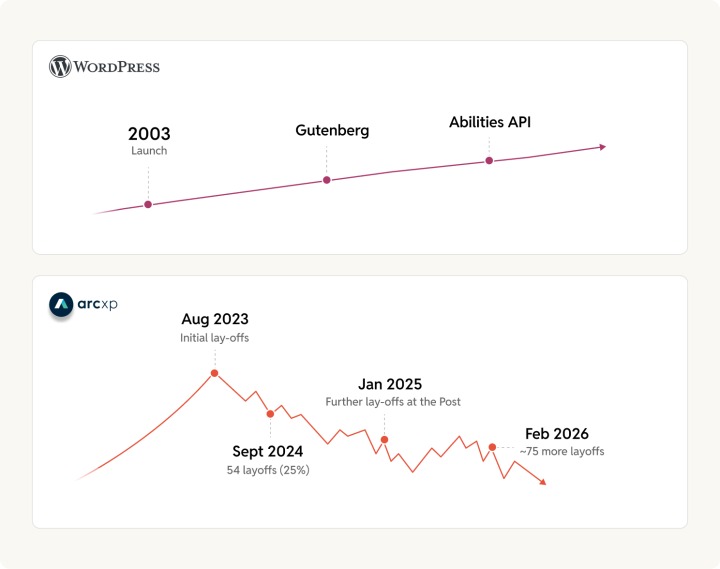
Arc XP’s long-term stability has raised concerns amid 130+ layoffs, a $77M loss in 2023, and a 12% decline in revenues since 2021. In 2022, The Washington Post explored selling Arc XP, and the Google News Initiative has cited lingering uncertainty around future ownership for publishers evaluating the platform.
For a publisher whose content delivery, subscriptions, video, and editorial workflow all run through a single vendor, that uncertainty translates directly to operational risk.
The WordPress ecosystem is stable
WordPress is structurally immune to instability of this kind. Its open-source foundation powers over 43% of all websites globally. Millions of developers, thousands of agencies, and more than two decades of community investment sustain it.
WordPress VIP runs purpose-built private infrastructure across 28 global data centres with horizontal auto-scaling and a built-in CDN. During the 2024 U.S. election, VIP served 22 billion requests with 100% uptime across publisher sites.
Major media houses like The Indian Express power over 80 million monthly users via WPVIP.
If Automattic (the company behind WordPress.com and WordPress VIP) stepped back tomorrow, the platform would continue without interruption. So would its hosting companies and agencies in the community. No single company’s fortunes can threaten the platform, because no single company owns it. That’s how open-source infrastructure works.
CMS architecture: Monolith, Headless or Hybrid
| Architecture factor | Arc XP | WordPress |
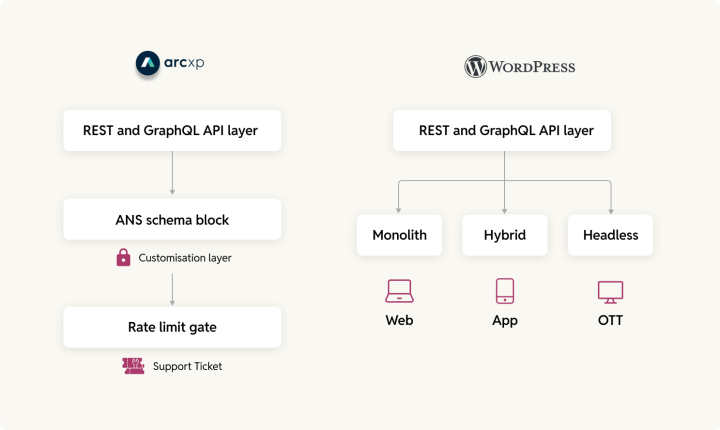
| Delivery model | Hybrid, headless; Server-side rendering (SSR)/Client-side rendering (CSR) via PageBuilder Engine | Monolith, hybrid, and headless from one core |
| Front-end framework | React via PageBuilder Engine | Your choice of framework (React, Next.js, Nuxt, Astro, custom) |
| API standards | REST + GraphQL (Proprietary ANS schema; GraphQL validation limited since Page Builder Engine 2.2) | REST + WPGraphQL (Open schema) |
| Schema customisation | Developer engagement | Same with WordPress |
| Rate limit control | Vendor-negotiated; increases require a support ticket | Configured by your team at the infrastructure level |
Architecture determines how quickly you can reach new surfaces, how much it costs to launch a new channel, and whether your platform keeps pace as audience behavior shifts.
Arc XP’s React-first architecture makes alternatives harder
Arc XP is a hybrid Digital Experience Platform (DXP) that supports hybrid, headless, and server-side/client-side rendering through its React-based PageBuilder Engine. For publishers with stable, web-first distribution needs, that’s a capable and modern setup.
The constraint is framework lock-in. Arc XP’s primary frontend lives on React via PageBuilder Engine. You can use other frameworks through their API layer, but extending components outside React requires significantly more effort than it should.
WordPress = Any Framework, Any Frontend
WordPress supports traditional, hybrid, and headless delivery from the same open core—and uniquely, publishers can move between them incrementally without a platform migration.
Running server-rendered pages today? That works natively.
Shifting to a decoupled front end on Next.js, Nuxt, or Astro while keeping editors in Gutenberg? REST API and WPGraphQL handle it.
Need a hybrid model as your strategy evolves? You move on your timeline, with any framework your team prefers, without rebuilding your editorial stack.
Arc XP gates API usage; WordPress opens it
Both platforms expose REST and GraphQL. The difference is what sits beneath them.
Arc XP’s APIs route through its proprietary ANS schema. As of PageBuilder Engine 2.2, GraphQL schemas no longer verify content structure, reducing GraphQL to a query interface rather than a validated content contract. Customizing beyond ANS defaults routes back to the vendor.
WordPress exposes the same interfaces via WPGraphQL against an open, publisher-owned content schema; fully validated, fully configurable, no vendor involvement required.
Freedom to set rate limits on WordPress
Arc XP rate limits are set per organization through vendor negotiations and tied to factors such as editorial headcount, publishing volume, and traffic. Raising them means opening a support ticket, working through the vendor’s optimization checklist, and waiting.
On WordPress, rate limits are configured at the infrastructure level by your team; no ticket, no checklist, no approval process to publish at the speed your audience demands.
Digital asset management (DAM): Bundled convenience versus best-of-breed control
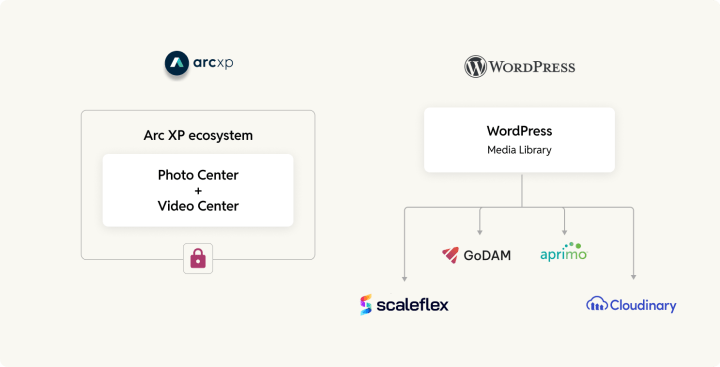
A DAM gives publishers a single source of truth for every media asset – images, videos, and documents making it easier for distributed teams to find, reuse, and govern content consistently across brands and channels.
The question for publishers isn’t whether to have one, but whether it should be bundled into your CMS or built as a dedicated layer alongside it.
| DAM factor | Arc XP | WordPress |
| Approach | Bundled (Photo Center + Video Center) | Open ecosystem; publisher chooses DAM |
| Editorial integration | Native; tightly woven into Composer | Native; works within Gutenberg |
| Brand governance | Limited; one vendor controls scope | Via dedicated DAM providers (Bynder, Aprimo, Scaleflex) |
| Video capabilities | Video Center: transcoding, live streams, ad integration—more mature | GoDAM: transcoding, adaptive streaming, interactive layers |
| IPTC metadata support | Photo Center: supported natively | Provider-dependent |
| Multi-site asset sharing | Limited via WebSked Collections | GoDAM Central: Upload once, reuse across network |
| Asset portability | Tied to the Arc XP platform; external access to unpublished assets is restricted | Full; publisher-owned |
| Custom metadata | Requires vendor involvement | Configurable per provider |
| Vendor flexibility | Locked vendor; no alternative | Switch providers without touching the CMS. |
Arc XP: Integrated from day one
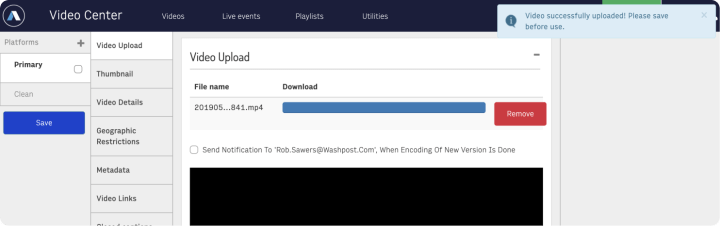
Photo Center and Video Center are built-in; assets are available inside Composer with metadata, usage tracking, and version history from the moment you go live. No integration work is required.
Video Center covers transcoding, live streaming, and ad monetization. Native IPTC metadata supports publishers with legal obligations around image identification.
The constraint is that everything must sit within one vendor’s platform. Asset portability is limited, external access to unpublished content is restricted, and extending the DAM beyond its defaults means going back to the vendor.
WordPress: CMS and DAM as complementary layers
WordPress treats DAM as a dedicated capability alongside the CMS, not folded into it—which reflects how enterprise publishers actually operate. Brand governance, rights management, cross-team collaboration, and multi-channel distribution are all better served by purpose-built tools than by a CMS trying to do everything.
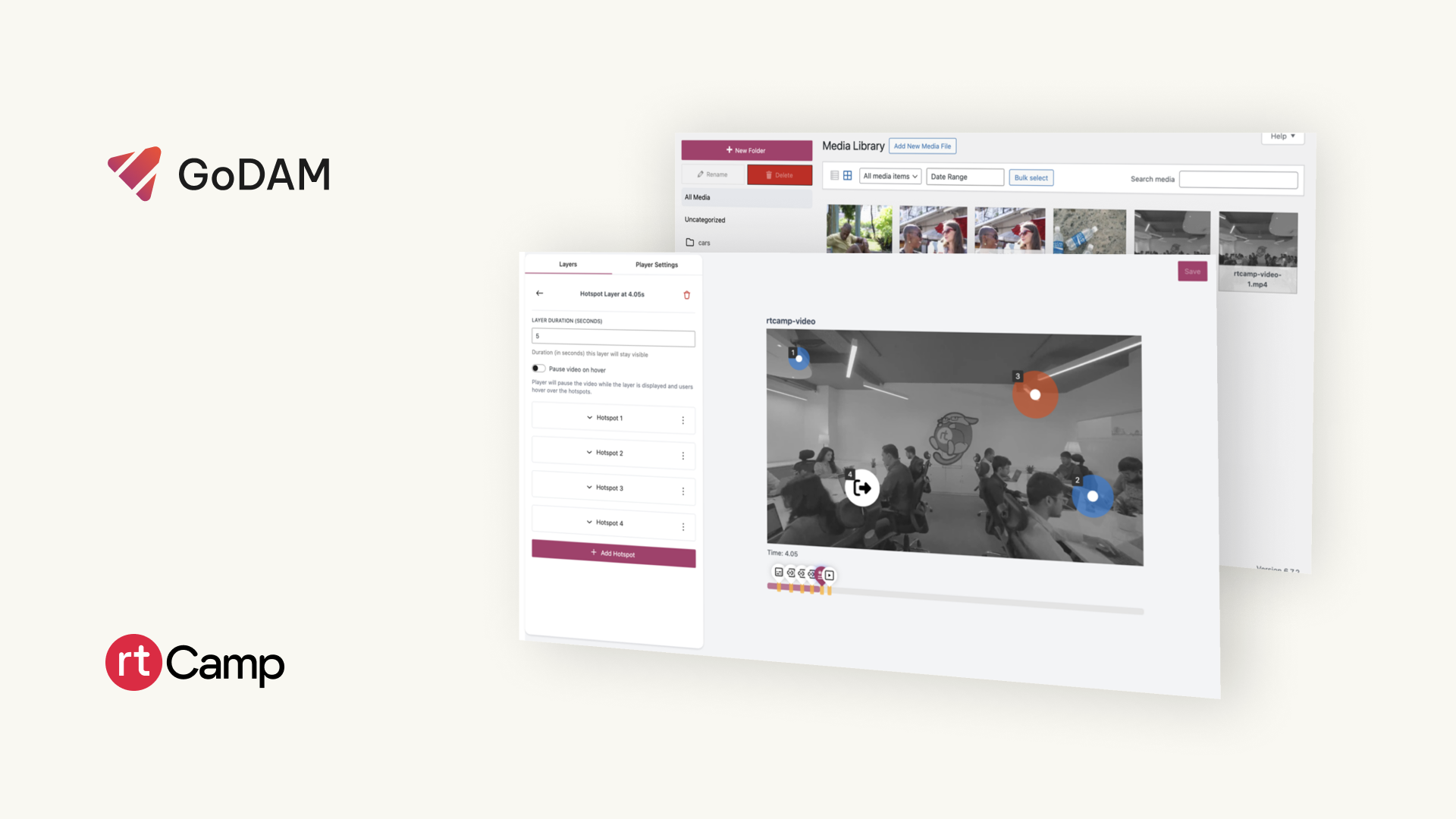
GoDAM, built by rtCamp, extends the WordPress media library with:
- Folder organization, metadata tagging, and search
- Video transcoding, adaptive streaming, and interactive layers (CTAs, forms, hotspots, in-video ads)
- GoDAM Central for asset sharing across multi-site networks
It’s a strong option that can be augmented with other DAM providers.
For example, if you want to implement brand governance at scale, Cloudinary, Scaleflex, and Aprimo all integrate natively with WordPress VIP and can be swapped without a platform migration. Publishers choose the tool that fits their operation today—and change it when their needs shift.
Editorial workflow: Turnkey versus yours
| Factor | Arc XP | WordPress |
| Editing interface | Split: Composer (content) + PageBuilder (layout) | Unified block editor (Gutenberg) |
| Editorial calendar | WebSked: tight, polished integration | PublishPress (custom workflow states), or any of dozens of alternatives, or a custom solution |
| Conditional workflows | Requires vendor involvement | Configurable without support tickets |
| In-editor AI | Headline generation, tag recommendations | Jetpack AI, ClassifAI (drafting, summarization, image generation), or a custom solution |
| SEO AI tools | Requires Semji partnership | Yoast, RankMath: AI-powered title, meta, SERP prediction |
| LLM provider choice | Vendor-dependent, roadmap-gated | Any provider: OpenAI, Anthropic, Gemini, or custom |
Where Arc XP is strong
WebSked is a polished editorial planning tool. Its “write once, publish everywhere” distribution pipeline was built for high-volume newsrooms running a predictable, linear workflow: assign, draft, approve, publish across channels.
Composer complements it with in-line comments, Slack and Teams notifications, and color-coded revision histories: tools that keep an editorial team moving without leaving the platform.
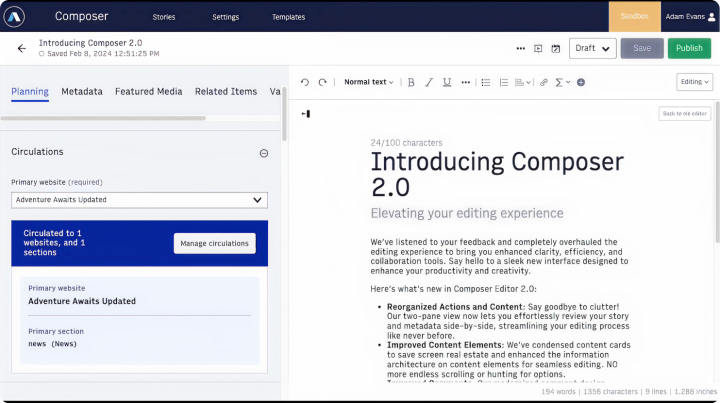
For teams whose editorial process fits that model, it works efficiently from day one. The GNI assessment confirms that authors and editors value the UX, and that the vendor’s customer support and account management are “well regarded.”
Where Arc XP’s editorial workflow creates friction
The GNI’s independent developer assessment is blunt: Arc XP is “very developer-intensive,” and developers find it “arcane, inconsistently documented, and not always leveraging AWS best practices.”
The editing experience splits across two interfaces (Composer for content, PageBuilder for layout), and conditional logic (legal review gates, regional approval chains, audience-specific rules) requires vendor involvement to implement. The moment your workflow diverges from the model the platform was built for, you’re filing tickets instead of publishing.
WordPress takes a different approach
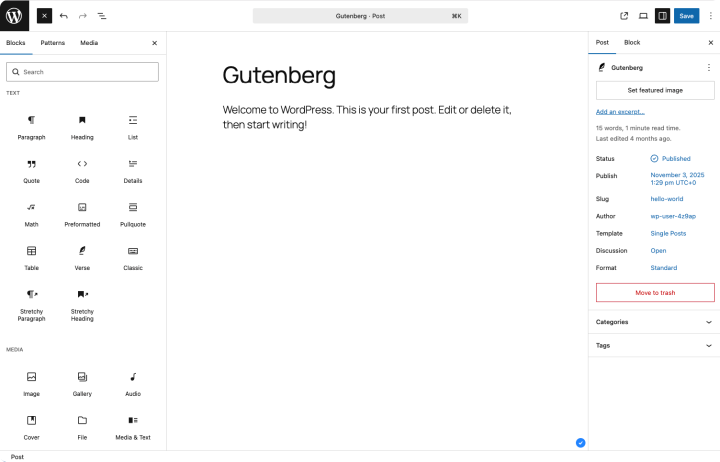
Gutenberg provides a unified interface for content and layout. For editorial planning, you choose the tool that fits your newsroom (PublishPress, Edit Flow, CoSchedule, or a custom solution) rather than accepting the single option your vendor ships.
Multi-team routing, conditional publishing rules, legal gates, and regional permissions are configurable without support tickets.
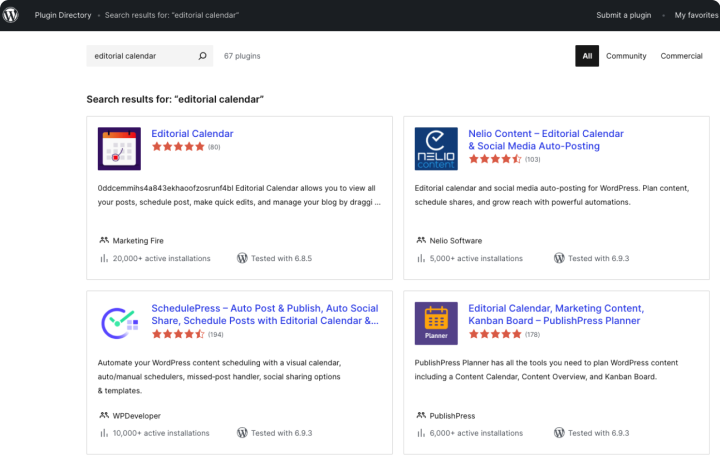
And if your hosting provider doesn’t meet your needs, you migrate to another one without rebuilding your editorial stack. The trade-off is real: more assembly up front. But the ceiling on what you can build is yours to define, and no single vendor can take it away.
AI readiness: Open architecture versus a vendor’s roadmap
AI in publishing is moving on a monthly cycle. Your CMS either lets you plug in what’s best today, or makes you wait.
Arc XP offers an AI Editor with headline generation, tag recommendations, audio article creation, and translation support. A functional starting point. But its broader AI capabilities are gated by the same architecture that limits everything else on the platform, and the roadmap is the vendor’s, not yours.
On WordPress, the AI toolchain is already working:

- Jetpack AI handles drafting, summarization, and image generation inside the editor. You can also choose from other similar options.
- Yoast and RankMath use AI for SEO before you publish.
- AI Engine powers on-site personalization and audience segmentation without a separate vendor relationship.
- Due to WordPress’s open architecture, you can operate a “Bring Your Own Keys (BYOK)” policy where you can integrate OpenAI, Anthropic, Gemini, or any emerging model without asking anyone’s permission.
WordPress 6.9’s Abilities API, a part of the WordPress AI Building Blocks project, takes these further, exposing AI workflows as composable, discoverable actions accessible via REST, WPGraphQL, or MCP adapters. It points toward a level of AI flexibility that closed platforms cannot match by design. rtCamp, for example, has a team deeply engaged with this initiative.
Security and compliance: One gap can end the conversation

| Security criteria | WordPress (ecosystem) | Arc XP |
| FedRAMP authorisation | Moderate ATO via VIP (April 2025) | Not authorised |
| SOC 2 Type II | WP VIP, Pagely: yes | No |
| ISO 27001 | VIP: yes | Yes |
| DDoS protection | Network-wide across major hosts | Via Akamai partnership |
| Government/regulated use | Qualified (White House, NASA, Department of Veterans Affairs via VIP) | Disqualified by FedRAMP gap |
For most commercial publishers, both platforms offer credible enterprise security. The comparison ends quickly for anyone in regulated industries, serving government clients, or bidding on public-sector contracts.
Arc XP’s compliance credentials fall short
Arc XP holds ISO 27001 and relies on AWS-native security tooling. Credible for commercial use. But it is not FedRAMP authorized and does not hold SOC 2 Type II as a platform. For any publisher whose contracts, audience, or ambitions touch regulated or government-adjacent territory, that gap closes the door before the conversation about features begins.
WordPress excels in overall compliance
Within the WordPress ecosystem, security credentials vary by hosting provider, so publishers can align their compliance requirements with the right tier.
WordPress VIP achieved FedRAMP Moderate Authority to Operate in April 2025, sponsored by the Department of Veterans Affairs, covering 325+ security controls from the NIST 800-53 framework. It’s the first and only managed WordPress platform to achieve this.
Pagely (another rtCamp partner) and WP VIP hold SOC 2 Type II certification. Pagely runs exclusively on AWS infrastructure. Other enterprise hosts like Pantheon and Kinsta offer their compliance tiers.
Publishers in highly regulated or government environments choose WordPress VIP; those with standard enterprise security requirements have strong options at different price points. With Arc XP, you get one security profile from one vendor. There’s no choosing the tier that fits.
Your CMS vendor competes with you for readers
This is the part of the conversation most comparison articles skip entirely.
Your potential competitor owns Arc XP
Arc XP is owned and operated by The Washington Post, a digital media company that competes directly with many of the publishers it sells to. Publishers on Arc XP are funding the infrastructure of a company that competes with them daily for audience, ad revenue, and subscribers.
Fortune reported that the Post licensed its publishing infrastructure to competitors, including Tronc/Tribune Publishing, while competing with them for the same readers and advertisers.
WordPress is neutral with no competing interests
WordPress has no competing media interests at any layer of the stack. Automattic’s business is infrastructure, not journalism. Pagely and the broader hosting market are technology companies, not media companies. CNN, Bloomberg, Al Jazeera, and Billboard all run on WordPress. None of them competes with their platform provider for the editorial audience.
This is an inherent conflict that affects product decisions, feature prioritization, and data access. When your CMS vendor is also your competitor, whose interests get served first?
Running multiple brands? The architecture matters more than the feature list
Multi-brand publishers face a challenge single-site comparisons miss: how do you give each brand editorial independence while maintaining governance, shared infrastructure, and cost efficiency at the network level?
Arc XP’s struggles with distinct editorial brands
Arc XP’s WebSked Collections feature distributes content across properties with shared design principles and role-based permissions. It works for content sharing.
The GNI assessment notes, however, that Arc XP “reflects the Post’s editorial approach and workflow and may not downshift effectively” to different operational models. As a tool for managing independent brands with distinct editorial identities, it’s limited, and extending it requires vendor involvement.
WordPress gives each site its editorial identity
WordPress multisite handles 1,000+ sites from a single installation, and this capability works across hosting providers, not just one. On any enterprise WordPress host, network administrators control code, plugins, themes, and user access at both the site and network levels. Multi-language support is built in per site.
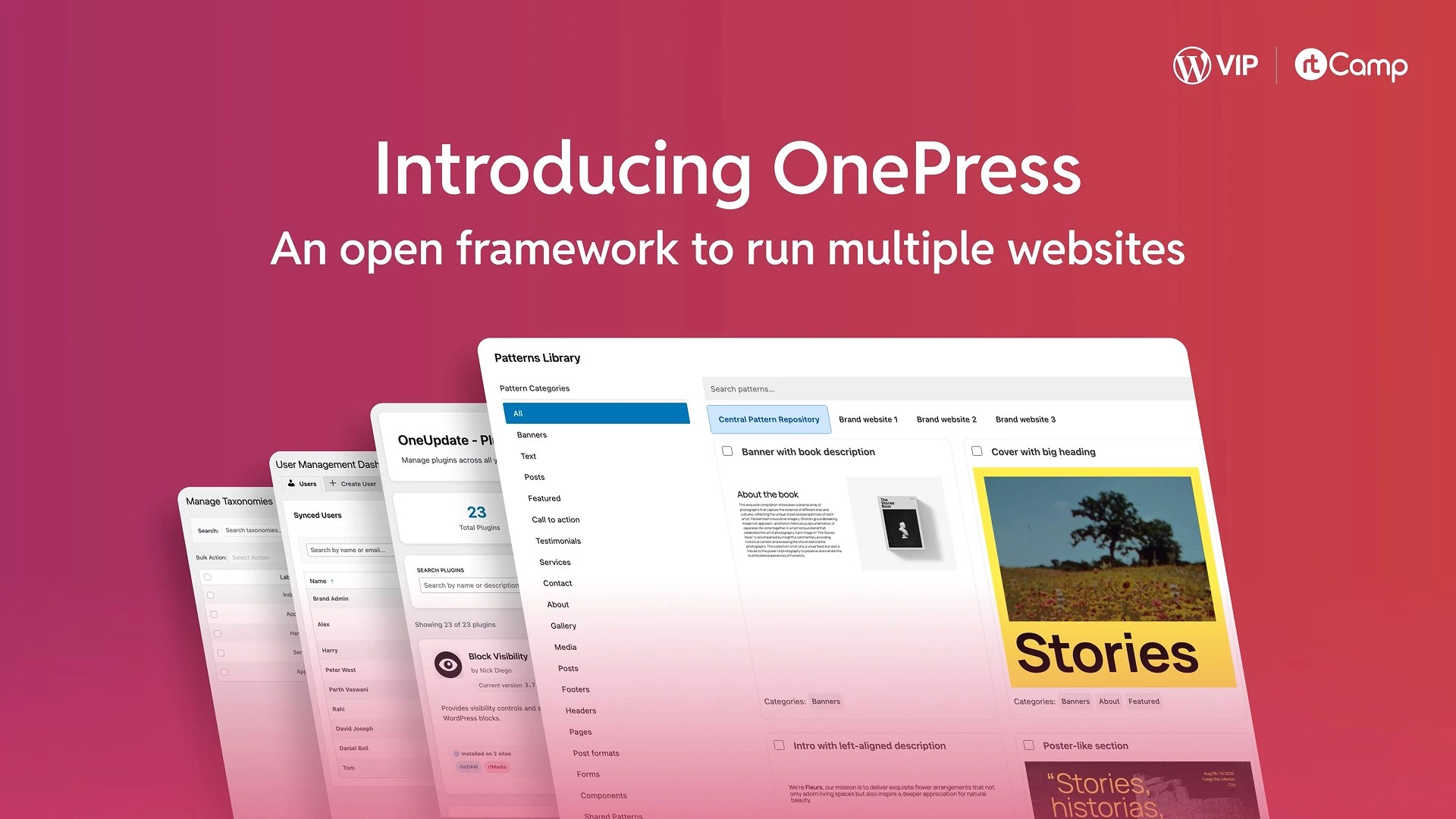
rtCamp’s OnePress framework extends this further: shared governance with full editorial autonomy per property, built for media groups managing multiple brands or regional editions at scale. If your multisite needs outgrow one host, you move. Your network architecture comes with you.
Monetization: Your revenue model shouldn’t live on someone else’s roadmap
Publishers are running complex revenue models: paywalls, memberships, event ticketing, e-commerce, and direct deals. The question is who controls that complexity.
Arc XP includes simple monetization tools
Arc XP bundles native subscription tools into its SaaS suite. For simple paywall needs, it works out of the box. Anything beyond the defaults (custom pricing logic, tiered access rules, third-party payment integrations) goes back to the same vendor engagement model covered in the cost section above.
The GNI assessment notes that Arc XP’s subscription module provides metrics but “not real analytics,” limiting the data-driven iteration modern revenue teams need.
WordPress offers full control over how you monetize
WordPress gives publishers full ownership. Open API standards (REST, WPGraphQL) integrate with leading monetization partners like Piano, Zuora, Stripe, Salesforce, and WooCommerce.
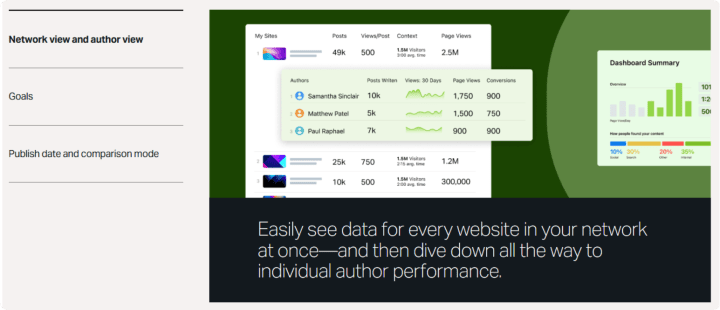
WordPress VIP’s Parse.ly adds real-time content performance data, conversion tracking, and a content API for personalised recommendations, giving revenue teams the analytics layer that Arc XP’s Content Stats dashboard lacks.
And you can swap components as business models evolve. You own the subscriber data. You own the revenue logic.
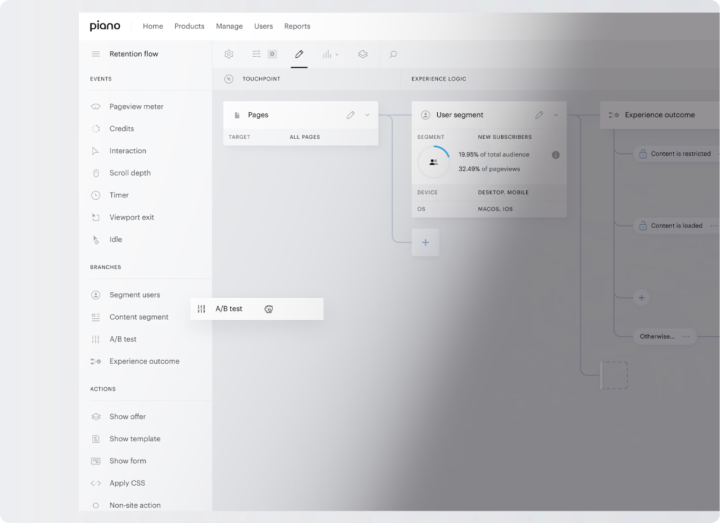
With 60,000+ free plugins and a competitive developer market, the cost of building custom monetization features stays manageable.
Revenue models evolve. The question is whether your platform evolves with them, or whether you wait for a vendor to ship the feature.
What does switching actually involve?
This is the question publishers ask last and should ask first.
Migration anxiety is real. Years of content, complex URL structures, redirects, audience data, subscriber records, and editorial workflows. Moving all of this is not trivial. We won’t tell you it is.
The content itself is rarely the hard part. Modern migration tooling handles structured export and import efficiently. What adds friction is Arc XP’s proprietary ANS data model, a non-portable schema designed around Arc’s platform.
Publishers report no native export button, API rate limits of 30 requests per minute, and CDN-hosted images served through authenticated URLs. These aren’t insurmountable barriers, but they require planning and expertise.
We’ve documented the process in detail: Arc XP to WordPress Migration Guide.
When Arc XP is the right call
Arc XP is a capable product. For a specific kind of publisher, it’s the right one. Consider it if:
- Your editorial workflows closely mirror The Washington Post’s model, and you want a turnkey setup that reflects it from day one.
- You’re deeply embedded in the AWS ecosystem and want your CMS to live there too.
- You need a fully bundled DAM, subscription management, and content planning suite, and want to avoid assembling a best-of-breed stack.
- Your workflows are linear and unlikely to require significant customization over time.
- The vendor instability, competitive conflict, pricing opacity, and limited flexibility are acceptable risks given those advantages.
If that profile fits your organization, Arc XP’s integration depth is a legitimate advantage worth weighing seriously. Just know that depth comes with one vendor’s walls around it.
The verdict
The case for WordPress is about control. WordPress gives you choices at every layer: hosting provider, agency partner, developer, plugin, AI tool, and monetization stack. On the other hand, Arc XP gives you one vendor for all of it.
Yes, WordPress is cheaper. But the real advantage is that WordPress is built for the way enterprise publishing actually works: editorial workflows that evolve, AI toolchains that change monthly, multi-brand operations that need both governance and independence, compliance requirements that don’t bend, and the need to move, publish, integrate, customize, and optimize. All without asking a vendor for permission.
Arc XP is a platform you rent, constrain yourself to, and depend on a single organization to maintain. Given the documented instability at that organization, the risk profile has shifted considerably.
For publishers who need flexibility, AI readiness, cost predictability, and infrastructure that outlasts any single vendor’s business cycle, WordPress is the stronger foundation. Not because of any one company in the ecosystem, but because the ecosystem itself is the competitive advantage.
Ready to explore the move? We’ve conducted 300+ enterprise platform migrations, and here’s precisely what the process looks like: Arc XP to WordPress Migration Guide.
We offer up to 20 hours of free scoping to map your specific migration before you commit to anything. Book your free scoping session today →
On this page


Leave a Reply