







Trusted by some of the world’s leading brands







Sounds familiar?
If you’re on Kentico Xperience 13, you’ve probably experienced at least one of these:

Every major upgrade approaches the cost of a full migration

Content scheduling fails…you find out when the page doesn’t publish

Your marketing team waits on developer tickets for changes they should own

The admin UI was already dated three years ago

You’re now being told XbyK is the “upgrade path” but it’s missing features you rely on
You’re leaving Kentico for the right reasons.Here’s what a bad migration puts at risk
83% of enterprise data migrations fail or exceed their budgets. Here are the three biggest risks in Kentico to WordPress migration, and how we prevent each one.

SEO performance
You’ve built ranking authority over years. Without proper URL mapping and redirect chain validation, none of that equity transfers.

How we prevent SEO deterioration
URL mapping audits, redirect chain validation, metadata field-by-field checks, and crawl simulations – all completed before DNS switch.

Content integrity
Bulk exports drop taxonomy relationships, media associations, and editorial metadata. Content arrives on WordPress editorially broken.
How we prevent content loss
Field-by-field migration planning from discovery. Every content object validated and tested against source before go-live.

Team productivity
Kentico’s publishing tools were built around Kentico’s constraints. The goal is to replace them with something that works much better than the previous setup.
How we prevent adoption failure
We map your team’s actual publishing operations and build around that. Live training and 30 days of Hypercare are standard.
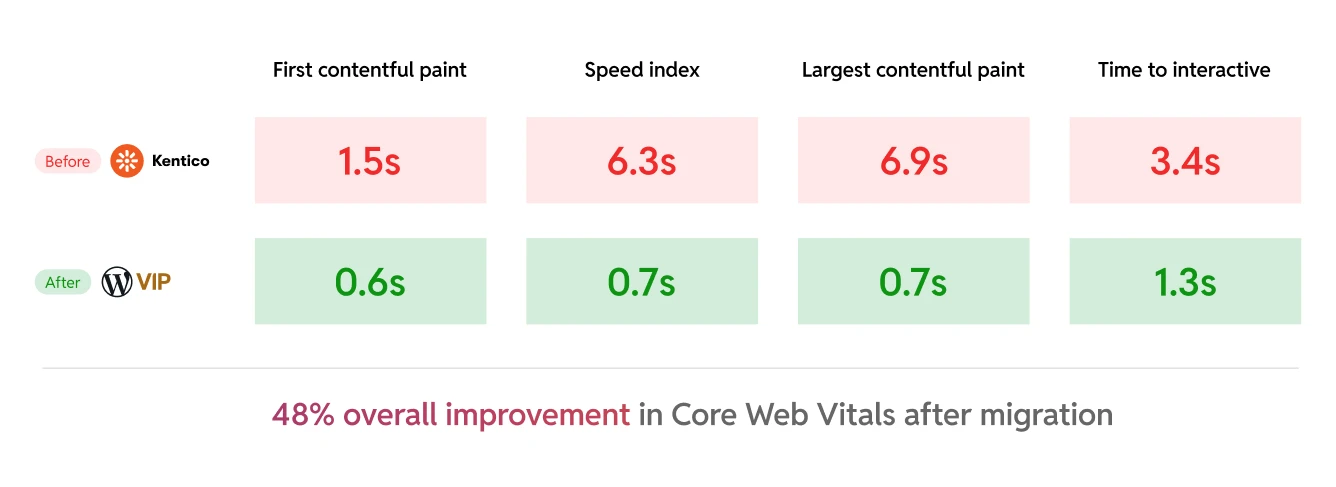
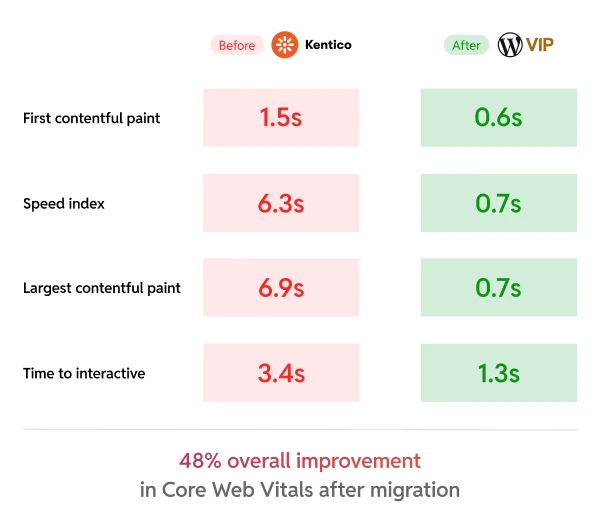
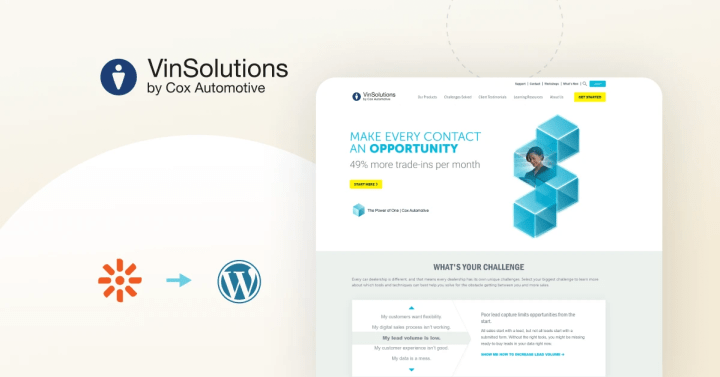
VinSolutions migrates fromKentico to WordPress VIP multisite with 48% better performance improvement

rtCamp has helped our organization in so many ways! Their incredible wealth of knowledge and experience around the WordPress platform has brought peace-of-mind to our teams and leadership.

Randall Benson
Senior Manager, Marketing Operations.
If you’re on Xperience 13, you’re replatforming either way.Here’s what each destination gives you
A practical comparison for teams evaluating Kentico to WordPress migration services while building the internal business case.
 Kentico XP13 Kentico XP13 |  Xperience by Kentico Xperience by Kentico |  WordPress WordPress | |
|---|---|---|---|
| Annual platform cost | Licensing fees + upgrade costs + developer-dependent customization. | Subscription licensing. Recurring costs replace one-off fees, but specialist dependency remains. | Zero licensing. You invest in what you build, not what you’re bundled. |
| Migration scope | You’re here. | Full replatform. Kentico’s own docs require content restructuring, API rewrites, and custom code rebuilds. | Full migration. Same effort, done once, on open-source infrastructure. |
| Feature parity | Your current feature set. | Built-in e-commerce and several KX13 modules not carried over. You may arrive with less than you left with. | No feature ceiling. Plugin ecosystem covers most needs; custom development covers the rest. |
| Security posture | Security-only mode since January 2026, All support ends December 31, 2026. | Security patches ship only for the latest XbyK release. Older versions stay exposed, the security depends on vendor’s release cadence. | Open-source core with continuous community security releases. WordPress VIP adds FedRAMP Moderate authorization, SOC 2 attestation, and automated vulnerability scanning. |
| Editorial independence | Page builder functional but rarely implemented well. Marketing teams recreate layouts manually. | Same editor paradigm. Workflow limitations follow the platform. | Gutenberg gives editors a block-based builder with on-brand components. No developer tickets for content changes. |
| Talent availability | Small developer community. Hiring is slow and expensive. | Same specialist pool. Demand increases as the KX13 EOL deadline forces migrations industry-wide. | 500,000+ developers globally. |
| Time to deploy changes | Complex configuration, environment setup, and deployment cycles. | Architectural changes require the same developer overhead. | Faster deployments supported by a mature plugin and tooling ecosystem. |
| Ownership | Vendor-controlled roadmap. You’re on their release schedule. | Vendor-controlled roadmap. A new platform, the same dependency. | Open source. You own every line of code and control your own roadmap. |
Both paths cost roughly the same to migrate. Only one of them ends here.
What you gain on WordPress
On WordPress, you own the infrastructure, control the roadmap, and your team can publish without waiting on developers.

Owned infrastructure
No licensing fees. Your codebase is yours. You can fork it, extend it, or change partners without replatforming.

Editorial independence
Gutenberg blocks give marketing teams an on-brand page builder. You can edit, publish, and update pages without developer tickets.

Composable architecture
Connect the best-of-breed tools you choose — analytics, CRM, ad tech, personalization — without buying a bundled vendor ecosystem.

The largest talent pool in CMS
50,000+ WordPress developers globally. WordPress VIP adds enterprise hosting, security, and support.
Our Kentico to WordPress migration service: how we do it
Our approach draws from 300+ enterprise migrations. Five phases, no big-bang launches. All engagements start with 20 hours of free discovery.
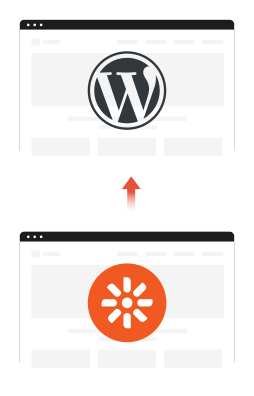
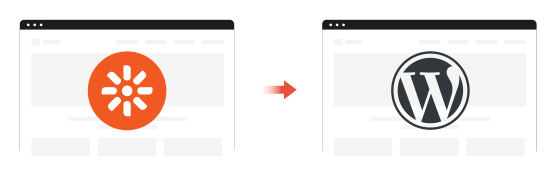
Migrate fromKentico to WordPress
Everything that matters,
protected
Every migration puts six things at risk. We engineer against all of them.
SEO equity preserved

Maintain your ranking authority across every URL
URL mapping audits, redirect chain validation, metadata field-by-field checks, and crawl simulation — all completed before DNS switch.
Content integrity validated

Transfer every piece of content without loss
Field-by-field migration planning, taxonomy and media relationship mapping, and checkpoint reviews at every stage of the process.
Editorial workflows rebuilt

Publish on day one without relearning everything
Gutenberg blocks and editorial tools designed around how your team actually works, not generic templates adapted after launch.
Integrations maintained

Keep your existing tools connected and working
CRM, analytics, ad tech, and marketing automation rebuilt and tested against production traffic before go-live.
Zero downtime deployment

Launch without taking your site offline
New platform built in parallel. Blue-green deployment with instant rollback capability. Your Kentico environment stays available until you’re ready.
Team enablement included

Operate the platform independently from day one
Our standard deliverables include technical and editorial documentation, live training sessions, and 30 days of dedicated Hypercare support.
Why choosertCamp as your Kentico to WordPress migration agency
We have proven enterprise WordPress development expertise.

Known for complex WordPress migrations
300+ enterprise CMS migrations. We moved Cox Automotive’s 8 brand sites from Kentico and AEM to WordPress with 103% more engagement, and up to 80% design reuse.

We’ll tell you if you don’t need us
If a simple Kentico upgrade fixes your problem, we’ll say so. Vendors that oversell create the problems we spend most of our time fixing.

WordPress VIP Gold agency
Core contributors for 34 consecutive WordPress releases. 200+ engineers in-house. SOC 2 compliant. 96% client repeat rate.
Why enterprises trust rtCamp
What ourclients say
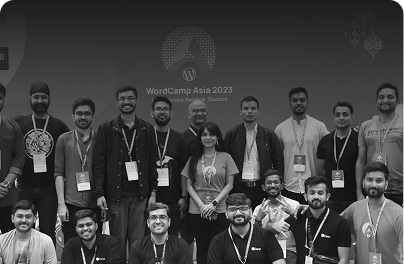
We started off young, back in 2011, with an idea that evolved into a big company.

rtCamp has helped our organization in so many ways! Their incredible wealth of knowledge and experience around the WordPress platform has brought peace-of-mind to our teams and leadership. Not only have they built us sustainable enterprise-class WordPress sites, but they have also helped streamline our go-to-market process with the solutions they have helped us architect.


Turnaround time for our article publication has been significantly reduced, with the added benefit of my team being able to put together content much quicker and more consistently, meaning my job as editor is made easier.
Planning to move from Kentico to WordPress?
Book a free consultation and we’ll recommend the right approach.
Check outour resources
Frequently asked questions
Xperience by Kentico is a full replatform, not a version upgrade. Kentico’s own documentation says so. It requires content restructuring, API rewrites, and custom code rebuilds. You also stay on a proprietary roadmap, with a small developer pool and subscription licensing. WordPress requires the same migration effort once, then gives you open-source infrastructure, backward compatibility, and 50,000+ developers. Most teams making this decision find the migration cost is nearly identical; what differs is where you end up.
It depends on site complexity, content volume, number of integrations, and customization requirements. Most first engagements range from $50K–$250K. We start every project with up to 20 hours of free discovery to map your architecture and scope the work — before any contract is signed.
A typical enterprise Kentico migration takes 3-6 months depending on content volume, number of integrations, and editorial workflow complexity. We deliver in phases so your live site is never at risk.
Not if the migration is handled correctly. We audit every URL before migration begins, validate redirect chains, migrate metadata field by field, and run a crawl simulation before DNS switch. Cox Automotive’s migration with rtCamp improved Core Web Vitals by 2X.
Yes. We can recreate your current Kentico design pixel-for-pixel on WordPress, or you can use the migration as an opportunity to redesign. Either way, the visual transition is seamless.
We map every Kentico feature, including forms, workflows, integrations, custom modules to WordPress equivalents during discovery. Some are handled by existing WordPress plugins, others require custom development. You’ll know exactly what’s being rebuilt and how before development begins.
No. We build the new WordPress platform in parallel while your Kentico site stays live. At launch, we use a blue-green deployment with DNS switch and instant rollback capability. Your Kentico environment remains available as a fallback.
Yes. Documentation, live training, and 30 days of Hypercare support are standard deliverables. Most enterprise teams are fully self-sufficient within weeks. If you need ongoing support, we offer maintenance packages and growth retainers.
WordPress is fully secure with the right implementation. Security comes from right architecture, hosting, access control choices, and operational discipline. WordPress VIP provides FedRAMP compliance, DDoS protection, and 24/7 security monitoring. rtCamp is SOC 2 & ISO27001 compliant and enforces controlled plugin governance on every project.
Look for a company with documented enterprise migration experience. Other key signals are: a planned discovery process and a team well-versed in content migration, SEO preservation, and integration rebuilds. rtCamp has completed 300+ enterprise CMS migrations, maintains a 96% client repeat rate, and starts every engagement with up to 20 hours of free discovery.