







What enterprise WordPress development really means
Enterprise websites are not digital brochures. They’re business systems that happen to have a frontend.
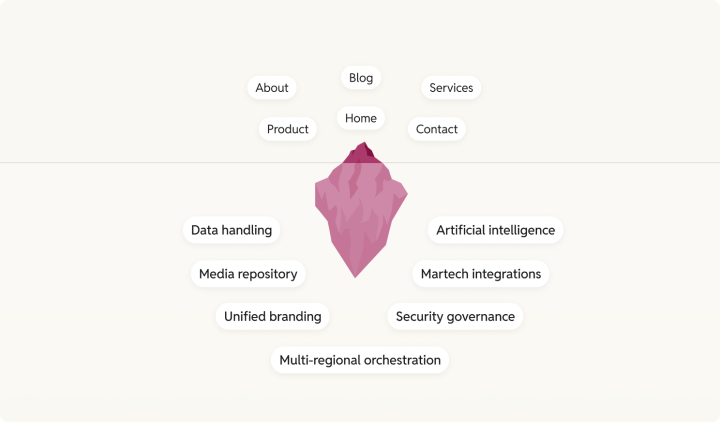
Most people miss this. They see a homepage, an about page, a blog. They assume the complexity ends there. It doesn’t. Behind every enterprise website sits data integrations, security protocols, editorial governance, multi-regional publishing workflows, and compliance infrastructure. The visible website is only 10% of what was actually built.
People who don’t work with enterprise websites underestimate the complexity. And people who do work with enterprise websites underestimate WordPress. Both miss the same thing: WordPress dominates enterprise publishing because it focuses relentlessly on what matters. Intuitive editorial experience. Out-of-the-box SEO. Backward compatibility that doesn’t break your site every upgrade cycle. Full ownership of your data and platform.
While other platforms chase architectural complexity, WordPress accelerates publishing. That’s why it powers 43% of the web and runs enterprise sites for the White House, NASA, News Corp, Disney, Salesforce, and Meta.
At rtCamp, we’ve led 300+ enterprise WordPress implementations. Here’s what that scope actually looks like.
Enterprise websites run parallel content operations, not a single blog
A small business publishes one content stream. Maybe two. Enterprises publish dozens simultaneously.
News, corporate communications, investor relations, product documentation, careers, customer support. Each stream has its own editorial team, publishing cadence, and audience. They share branding and infrastructure but operate independently.
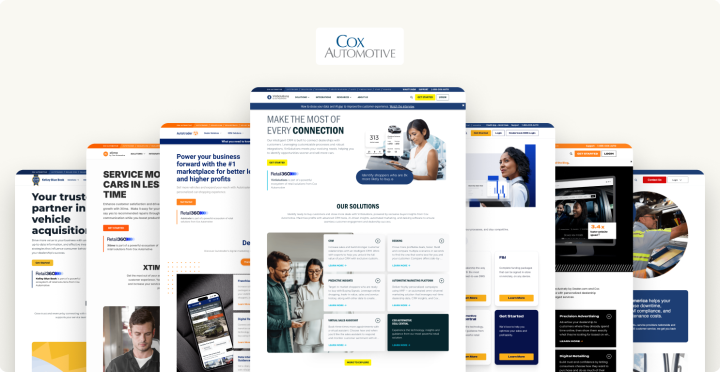
Cox Automotive runs 8+ brand websites across its automotive services portfolio. Before consolidation, that meant eight separate codebases, eight maintenance schedules, and brand consistency measuring at just 2%. Each brand needed autonomy over content while sharing core infrastructure. This isn’t a blog with categories. It’s a multi-tenant publishing platform.
Marketing teams also need campaign pages that spin up fast, run for a defined period, and disappear without polluting navigation. This requires content lifecycle management beyond simple “Draft” and “Published” states.
For multinational enterprises, add language and regional variations. Al Jazeera operates 70+ bureaus worldwide, publishing around the clock in multiple languages. Proper multilingual architecture means hreflang tags for SEO, regional content variations, locale-specific compliance, and translation workflows. Localization is architecture, not an afterthought.
WordPress Multisite networks and open frameworks like OnePress let enterprises manage this complexity from a unified codebase while preserving brand autonomy where needed.
Structured content models replace simple categories
Enterprise content carries metadata: product attributes, author credentials, publication dates, content types, audience segments, geographic relevance.
This metadata powers everything downstream. Schema markup for rich search results. Personalization engines serving relevant content. Faceted navigation helping users find what they need. Analytics revealing performance by dimension.
It also powers relationships between content. Case studies relate to services. Blog posts reference products. News articles mention executives. Salesforce manages thousands of pages where each piece connects to related content through defined relationships, not manually maintained links that break when URLs change.
When you have 50,000 pages, WordPress’s default search can be expanded with many options built on Elasticsearch, such as Enterprise Search by WordPress VIP.
FleetNet America manages a network of over 60,000 service providers. Basic keyword matching fails when providers search for clients, documentation, or account details. Search features at the enterprise level require Elasticsearch or similar tools handling fuzzy matching, synonym recognition, faceted filtering, and relevance ranking tuned to business priorities.
Users expect Google-quality search on your site. Anything less and they leave.
Enterprise websites serve, transact, and personalize
Visitors don’t just read. They authenticate, transact, and receive personalized experiences.
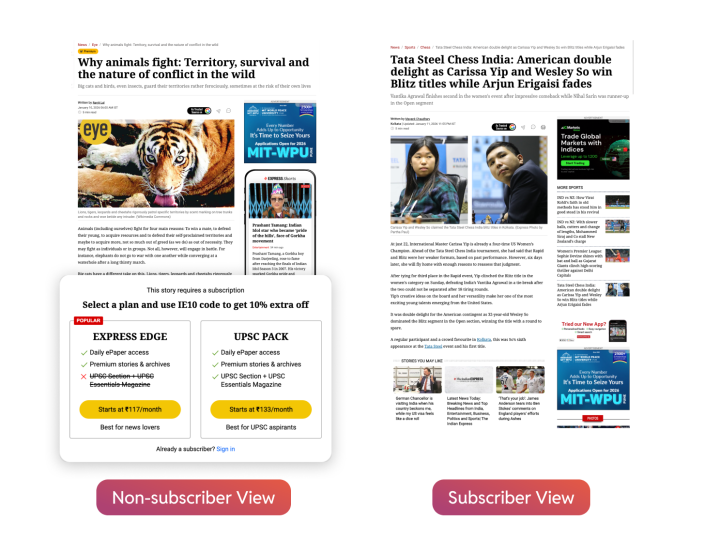
Investor portals require authenticated access. Partner resources live behind login walls. Customer documentation varies by subscription tier. Bloomberg serves different experiences to different users on the same platform. Subscribers see premium content. Free users see limited access. Institutional clients see specialized data.
Same URL, different experience.
WordPress ships with five default user roles. Enterprises need hundreds.
For example, partners access a dedicated portal, employees can view internal documentation, the public sees only marketing content, and regional managers can see content only relevant to their region. Global executives see everything.
This requires defining hundreds of custom user roles with specific privileges. Enterprise WordPress tackles that perfectly.
FleetNet America’s network spans 60,000+ service providers, each with different access levels, territories, and capabilities. This requires custom capability systems integrated with corporate identity providers through SAML or OAuth.
Single Sign-On integration with identity providers like Okta or Azure AD is table stakes for enterprises. Partners log in with existing corporate credentials and land directly in their portal, seeing only what’s relevant to their role. No separate passwords. No IT tickets for account resets.
Form submissions trigger business processes, not email notifications
Enterprise forms drive workflows: lead qualification, lead routing, application tracking, compliance documentation, CRM updates, etc.
Enterprise forms handle job applications, partner registrations, quote requests, event signups, and compliance documentation. These require multi-step workflows with conditional logic, file uploads, validation rules, and data that meets regulatory standards.
When a Fortune 500 company captures a lead, that data flows immediately into Salesforce, triggers an email marketing workflow, notifies the regional sales team, and logs everything in analytics. All within seconds. This happens through APIs and webhooks, not CSV exports.
New lead? Route to the right sales rep based on territory. Job application? Notify the hiring manager and create an entry in the ATS. Partner inquiry? Check against existing accounts and flag duplicates.
Grist, the nonprofit climate newsroom rtCamp supports, integrates WordPress with Parse.ly for analytics and content syndication systems tracking republished stories across partner publications. Every piece of content triggers downstream workflows for distribution, tracking, and reporting.
When forms collect sensitive information, encryption and secure transmission become mandatory. Enterprise integrations require TLS, tokenization, and compliance with GDPR and HIPAA.
Performance means auto-scaling infrastructure, not faster hosting
Product launches, earnings announcements, breaking news, viral campaigns. These create traffic spikes that overwhelm ordinary hosting.
WordPress VIP handles 100,000+ requests per second during peak traffic for major media properties. Enterprise infrastructure auto-scales to meet demand, then scales back down to control costs.
Speed expectations keep rising. Google’s Core Web Vitals influence search rankings. Users expect pages in under two seconds. Every additional second costs conversions.
Pasqal, the quantum computing company whose WordPress VIP site rtCamp built, saw Core Web Vitals scores jump from 66 to 90. For a company positioning itself at technology’s cutting edge, a slow website undermines that positioning.
FleetNet America achieved 2x improvement in Core Web Vitals after migrating from Drupal to WordPress VIP with rtCamp.
Enterprise WordPress deployments typically include object caching (Memcached or Redis), full-page caching via Varnish, database read replicas for high-traffic reads, Elasticsearch for search, and auto-scaling through Kubernetes.
Separately, enterprise WordPress hosts back their platforms with contractual uptime guarantees. For example, WordPress VIP offers 99.95% on standard plans and 99.99% on premium tiers, with service credits if they miss.
For global audiences, a server in Virginia doesn’t serve users in Singapore well. Enterprise WordPress deploys across global CDN networks, caching content at edge locations. Some architectures push logic to the edge too, handling personalization and A/B testing milliseconds from the user.
Publishing workflows enforce accountability
Enterprise content doesn’t go from draft to published in one click. A typical path: Draft → Editorial Review → Fact Check → Legal Review → Scheduled Publication. Each stage has assigned reviewers, SLAs, and approval requirements. Content can’t go live until every gate passes.
Grist manages complex editorial workflows across 40 journalists in 20 states. Cox Automotive operates eight brand websites with distinct editorial teams. Each brand controls its content while central teams maintain governance over shared components.
Enterprise WordPress implements granular permissions mapped to organizational structure. Marketing can edit campaigns but not pricing pages. Regional teams can update their content but not global messaging. Contractors can view brand assets but not download source files.
When regulators ask who approved that claim, you need an answer. Enterprise WordPress logs every edit, every approval, every publication, every user action. WordPress VIP maintains SOC 1 and SOC 2 Type II compliance, requiring comprehensive audit capabilities satisfying financial industry regulations.
Compliance requirements carry financial penalties
The regulatory environment has teeth.
PCI DSS 4.0 became mandatory in March 2025. Websites processing payments must inventory all client-side scripts and detect unauthorized tampering. Violations expose organizations to fines and liability.
The European Accessibility Act took effect in June 2025. Private sector websites in the EU must meet WCAG 2.1 Level AA standards. Fines reach €200,000 in some member states.
GDPR, CCPA, and SOC 2 impose additional requirements for data handling, privacy notices, and security controls.
Enterprise security goes beyond plugins. It includes Web Application Firewalls, DDoS protection, automated vulnerability scanning in CI/CD pipelines, external penetration testing, immutable infrastructure preventing file modification, and 24/7 monitoring with incident response.
WordPress VIP holds FedRAMP Moderate authorization, the only WordPress platform approved for U.S. federal government deployments. Pantheon maintains SOC 2 Type II and ISO 27001 compliance.
WordPress development for enterprises embeds compliance into the build process, not as an afterthought.
Multi-brand orchestration from a unified codebase
Enterprise ecosystems rarely mean one website. They mean 5, 10, 50, or 100+ sites across brands, business units, regions, and campaigns.
When each site runs as a separate installation, development effort duplicates. Brand consistency erodes as sites drift. Security patches require updating every instance. Design improvements benefit one site, not the portfolio. Technical debt compounds with each new launch.
WordPress Multisite enables enterprises to manage dozens of sites from a single installation. Shared plugins and themes deploy once and apply everywhere. Security updates roll out network-wide.
Enterprise design systems define reusable components: headers, footers, cards, CTAs, forms. In WordPress, these become Synced Patterns. Update a component in the central library and it propagates to every site using it.
Cox Automotive’s transformation with rtCamp’s OnePress framework delivered measurable outcomes. Each website now reuses 70-80% of designs, layouts, and plugins. Brand consistency went from 2% to near-total alignment. The results:
+103%
visitor engagement
+100%
lead conversions
+21%
website performance
Seven large websites launched within 12 months. A Content Hub lets teams publish content once and automatically distribute it across multiple sites.
Central IT controls infrastructure, security, and code standards. Local teams control content, campaigns, and regional customization. That’s leverage.
Is enterprise WordPress development right for you?
You likely need enterprise WordPress development if you:


Handle high traffic or mission-critical publishing
Require deep integrations with CRMs, ERPs, CDP, DAM, or other business systems
Rely on globally distributed editorial teams
Have compliance or security requirements (PCI DSS, GDPR, EAA)
Expect multi-environment development and DevOps workflows
Check three or more boxes? You’re in enterprise territory.
Enterprise WordPress is true enterprise software
The visual output of an enterprise WordPress site might look similar to a small business site.
The backend is a different animal entirely. It includes custom integrations, compliance automation, editorial workflows, and infrastructure that auto-scales under load.
True enterprise WordPress development combines:
- Engineering that handles scale, performance, and integration
- Governance that enforces workflows, permissions, and compliance
- Continuous delivery that enables rapid, safe deployments
Building software that runs a global business requires more than installing a premium theme. You need the support of an expert WordPress enterprise development agency.
The iceberg runs deep. For enterprises that navigate it correctly, the foundation is solid.
Ready to discuss your enterprise WordPress project? Connect with our team →
Frequently asked questions
How much does enterprise WordPress development cost?
Enterprise projects typically range from $150,000 to $1M+, depending on scope, integration complexity, multisite requirements, and ongoing support needs.
This reflects engineering depth: custom development with integrations, compliance implementation, performance optimization, and governance frameworks.
For comparison, Sitecore licensing alone runs $100,000-$500,000+ annually. Adobe Experience Manager can cost enterprises $250,000 to over $1M per year annually.
WordPress eliminates licensing fees. Total Cost of Ownership typically drops 40-70% compared to proprietary platforms.
Is WordPress enterprise-ready?
Yes. WordPress powers 43% of all websites and enterprise sites for the White House, NASA, Cox Automotive, PMC, News Corp, Disney, Salesforce, and more.
What makes it “enterprise-ready” extends beyond core software to the ecosystem surrounding it:
- Managed hosting (WordPress VIP, Pagely, Pantheon) provides enterprise infrastructure
- Headless and hybrid architectures enable omnichannel delivery
- Enterprise agencies implement governance, security, and scalability layers
The open-source foundation eliminates vendor lock-in. You own your data and your code.
What companies use WordPress for enterprise sites?
Enterprise WordPress spans industries:
Government
The White House, NASA
Finance
Standard Chartered, Bloomberg Media, AlphaTarget, Scripbox
Technology
Salesforce, Microsoft News, Meta, Pasqal
Entertainment
Disney, Sony Music
Automotive
Cox Automotive, FleetNet America, Lead Venture
These organizations chose WordPress for flexibility, cost efficiency, and access to a global talent pool of WordPress enterprise developers.
On this page


Leave a Reply